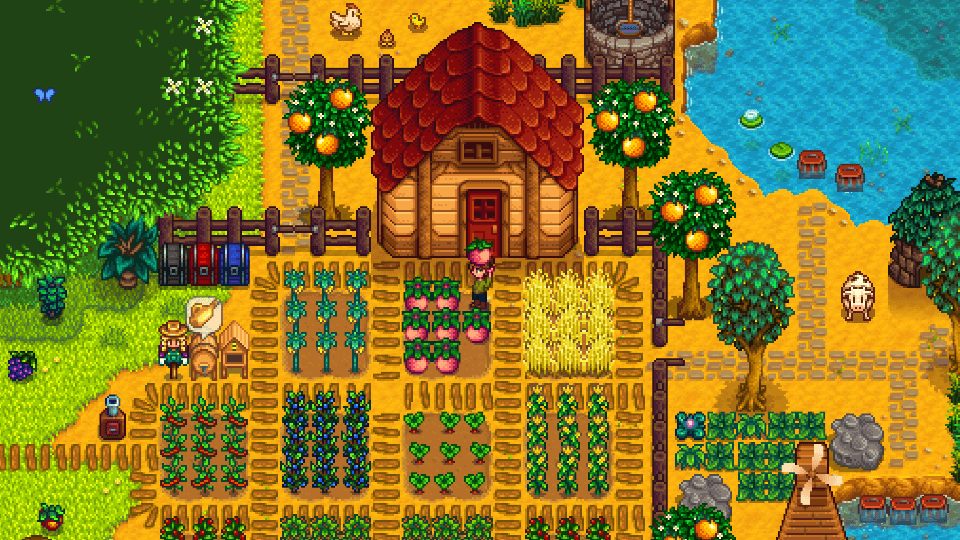
Do this first
- 01Decide whether crops, animals or a side skill should shape the home farm.
- 02Choose Standard if this is your first save and you do not yet know your long-term layout.
- 03Choose Four Corners when separate multiplayer zones matter more than one open field.
- 04Avoid Beach if your plan depends on covering most of the farm with sprinklers.
- 05Treat the choice as permanent for that save; you cannot switch maps later.
All eight farm maps at a glance
Every map contains the farmhouse and a building that can become the Greenhouse. The real differences are how much open farming space remains, which home-farm resources appear, and what layout problem you accept in exchange.
Standard Farm
First saves · crops · flexible layoutsThe largest open, tillable area and the fewest terrain constraints. It works equally well for crops, animals and large custom layouts.
Trade-offNo exclusive forage, quarry, fishing or combat advantage.
Riverland Farm
Fishing at homeIslands and waterways make farm fishing viable, and current versions start this map with a Fish Smoker.
Trade-offWater divides the land and leaves far less continuous space for crops and buildings.
Forest Farm
Foraging · hardwood · compact farmsWestern clearings produce seasonal forage, special weeds and eight renewable Large Stumps for hardwood.
Trade-offPonds and permanent grass areas reduce crop space and break up large layouts.
Hill-top Farm
Mining flavor · a home quarryA southwest quarry produces stones, ore and geode nodes that improve with Mining level.
Trade-offCliffs and a stream fragment the farm, and debris can block the quarry until tools improve.
Wilderness Farm
Night combat · challenge savesMonsters appear on the farm at night and scale with Combat level; high-level saves can encounter its exclusive Iridium Golems.
Trade-offCliffs and ponds reduce space, while farm monsters award only one-third normal Combat experience.
Four Corners Farm
Multiplayer · organized solo layoutsFour separated quadrants combine a large farming area with small Forest, pond and Hill-top quarry perks.
Trade-offDividing cliffs make one huge crop field or free-flowing building plan less convenient.
Beach Farm
Fishing · forage · animals · unusual layoutsA large scenic map with ocean fishing, seasonal forage and supply crates that can wash ashore.
Trade-offSprinklers do not work on most sandy soil; only a limited normal-soil area supports them.
Meadowlands Farm
Animals · alternative first yearStarts with a Coop, two chickens and 15 Hay instead of 15 Parsnip Seeds; Blue Grass gives animals an improved food source.
Trade-offIt offers less tillable land than Standard, and its farm fishing is unreliable.
Use Standard when you want options, not a gimmick
Standard is the safest recommendation for a first save because it postpones specialization. Its large continuous field makes sprinkler grids, barns, sheds, orchards and decorative redesigns easier to change later.
Four Corners is the practical alternative when organization matters more than openness. Each quadrant can hold a different job or player, while its small forest, pond and quarry areas provide a sample of other map perks.
- First solo save: Standard.
- Four-player or deliberately zoned farm: Four Corners.
- Large late-game crop grid: Standard is simpler.
Meadowlands changes the opening from crops to animals
Meadowlands is the only map that changes the basic starter package. You begin with a Coop, two chickens and hay instead of the usual parsnip seeds, so the first week naturally centers on feeding, petting and collecting animal products.
Its Blue Grass is more efficient for animals than ordinary grass, but the map is not simply a better Standard Farm. Water and untillable areas constrain crop expansion, so choose it because you want an animal-led start, not because it appears to include free buildings.
- Best animal-first opening: Meadowlands.
- Best blank canvas for mixed crops and animals: Standard.
- Do not follow a parsnip-only day-one guide without adapting it on Meadowlands.
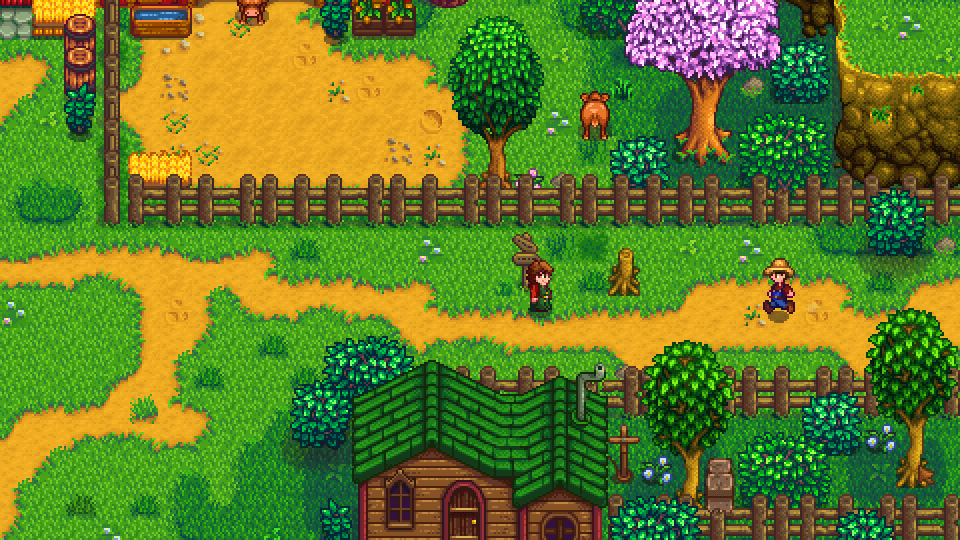
Forest, Riverland and Hill-top bring one skill home
Forest brings renewable hardwood and seasonal forage onto the farm. Riverland lets you fish useful river fish without leaving home and supplies a Fish Smoker. Hill-top adds a small quarry whose nodes improve as Mining rises.
These perks save occasional travel; they do not replace the Secret Woods, the wider fishing map or the Mines. Each specialized map gives up continuous farming area, so select the home activity you genuinely enjoy repeating.
- Forage and hardwood convenience: Forest.
- Frequent home fishing: Riverland.
- Mining atmosphere and passive ore nodes: Hill-top.
Wilderness and Beach are deliberate constraints
Wilderness adds night monsters, but it is a theme and challenge choice rather than a fast Combat-leveling method because farm monsters award reduced experience. The separate advanced option can enable monsters on other farm maps, so the terrain itself should still appeal to you.
Beach offers a large, attractive coast with fishing, forage and supply crates, yet most of its sand cannot use sprinklers. A normal-soil patch remains for automated crops, while the wider sand is better used for buildings, grass, animals or layouts that do not depend on mass sprinkler farming.
- Night combat as part of farm life: Wilderness.
- Fishing, forage and non-crop space: Beach.
- Heavy sprinkler farming across the whole map: choose another layout.
Official sources
Maintained comparison of all eight layouts, map perks, land constraints, starter differences and version history.
Stardew Valley Wiki · Checked Sep 28, 2026Official-site-linked beginner record for permanent map choice, favored skills and the Meadowlands starter package.
Stardew Valley Wiki · Checked Sep 28, 2026Official game premise and open-ended farming, fishing, community and cave feature boundary.
ConcernedApe · Checked Sep 28, 2026